From Day One Seattle · April 2026
From Purpose
to Outcomes
A Practical Path to More Strategic Leadership
An interactive breakout on strategic alignment
Too often, HR leaders are asked to be strategic but lack a clear path to get there. The result is work that feels reactive, disconnected, and difficult to tie to real business impact.
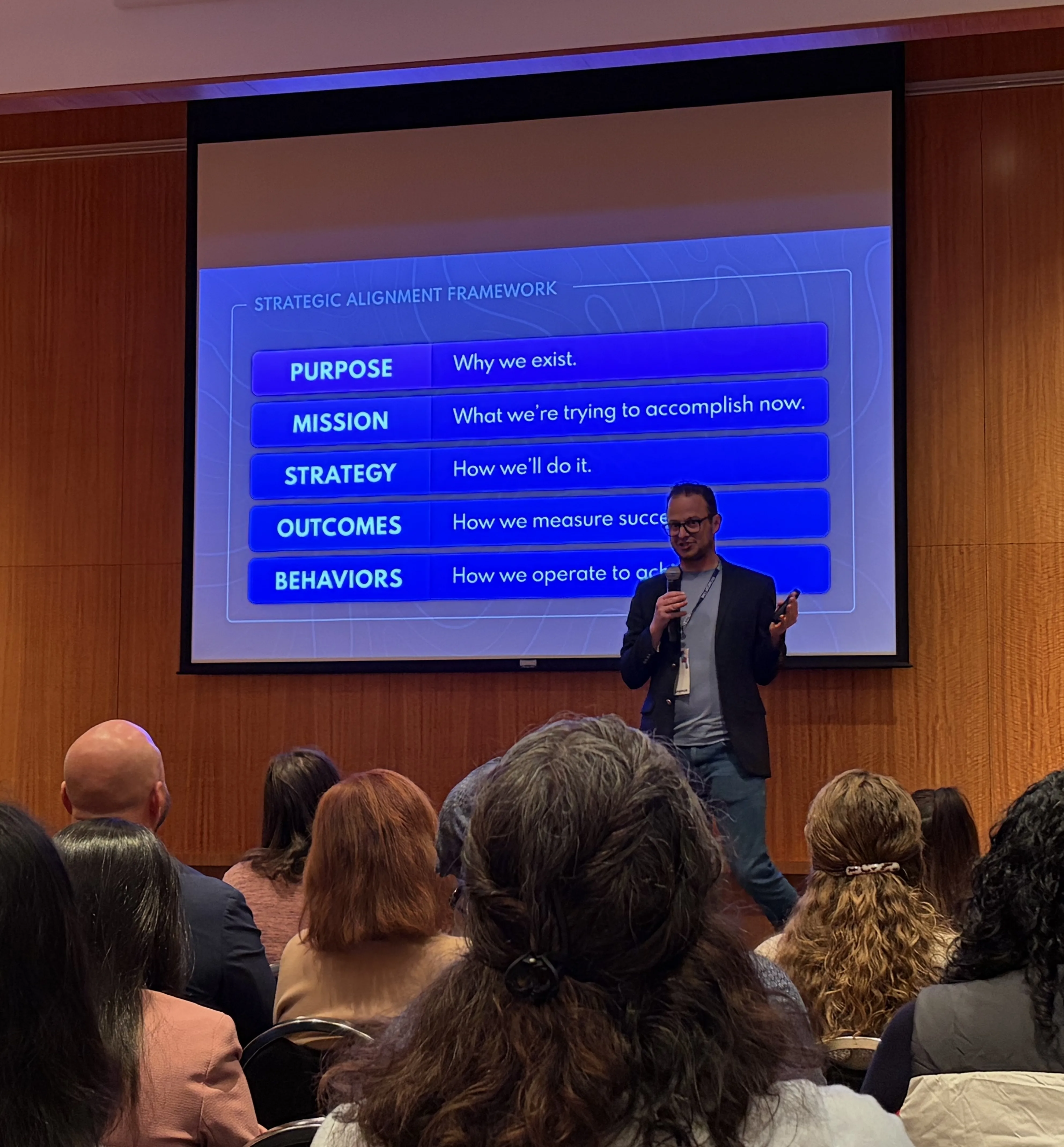
This session introduced a simple framework that connects Purpose to Mission to Strategy to Outcomes to Behaviors — giving leaders a clear line of sight from the work they lead to the results their business needs.
Most strategic work isn't strategic
Organizations invest heavily in strategy — then watch it dissolve into busywork, misaligned priorities, and disconnected teams. The gap between intention and execution is where most leadership development fails.
95%
of employees are unaware of, or do not understand, their company's strategy.
Kaplan & Norton, Harvard Business Review
60%
of knowledge workers' time is spent on 'work about work' — only 13% goes to strategic planning.
Asana, Anatomy of Work Index
70%
of strategic transformations fail to achieve their objectives.
McKinsey & Company
“The problem isn't that people don't care about strategy. It's that most people have never been shown how their work connects to it.”
— Steve Arntz
Strategic Alignment: A Simple Chain
Five connected levels — from the enduring reason you exist to the daily behaviors that make it real. When the chain holds, people move with clarity and confidence. When a link breaks, even great teams drift.
Purpose
Why we exist.
Purpose is the reason your organization was created. It doesn't change with market conditions or leadership turnover. It's the foundation everything else builds on.
Mission
What we're trying to accomplish now.
Mission translates purpose into a current, time-bound objective. It answers: what are we focused on right now to bring our purpose to life?
Strategy
How we'll do it.
Strategy is the set of choices about where to play and how to win. It turns the mission into a plan of action with clear priorities.
Outcomes
How we measure success.
Outcomes are the measurable results that tell you whether strategy is working. They create accountability and make progress visible.
Behaviors
How we operate to achieve it.
Behaviors are the daily actions and norms that either accelerate or undermine your strategy. Culture lives here — not on a poster.
“Leadership development only works when it is clearly tied to outcomes that matter most.”
— From Day One session description
How NASA Used This Framework
The Apollo program is one of history's clearest examples of strategic alignment. Every level connected — from an enduring purpose down to specific daily behaviors.
Purpose
Why they exist.
Explore the unknown in air and space. Inspire through discovery.
Mission
What they're trying to accomplish now.
Land astronauts on the moon through the Apollo program.
Strategy
How they'll do it.
Build the Saturn V Rocket. Develop Life-Support. Train Astronauts. Test Systems. Launch Apollo 11.
Outcomes
How they measure success.
Number of people who slingshot around the moon.
Behaviors
How they operate to achieve it.
Safety: See a problem? Speak up. Teamwork: We work across teams, together. Learning: Test consistently, fix mistakes, improve.
“
Misalignment doesn't happen because people don't care.
It happens because the connection breaks somewhere in the chain.
Where Alignment Breaks Down
Most organizations have some version of purpose, mission, and strategy written down somewhere. The problem isn't that these things don't exist. It's that they don't connect — and nobody talks about the gaps.
The say-do gap at the top
89% of CEOs say CHROs should play a central role in long-term profitable growth — but only 45% are creating the conditions to let them do so.
Accenture, 2023
HR trapped in admin
HR staff spend 57% of their time on administrative tasks, leaving a minority of time for the strategic initiatives organizations say they need most.
Deloitte
Values on a wall
There is zero correlation between a company's official stated values and how well employees say the company lives up to those values.
MIT Sloan Management Review, Donald Sull
Belief without behavior
Only 27% of employees strongly agree they believe in their organization's values. Just 23% can apply those values to their work every day.
Gallup
“The correlation between how heavily a company weighted a set of values and how well employees said they did on those specific values hovered around zero. Four of the correlations were actually negative.”
— Donald Sull, MIT Sloan Management Review
Your culture is not your values.
It's the behaviors your system reinforces.
Most organizations can recite their values. Few can honestly describe what actually gets rewarded, punished, promoted, or ignored. This is where the real culture lives — and where strategy either accelerates or dies.
🏆
What behaviors get rewarded?
e.g. Saying yes to everything, working long hours, being visible
⚠️
What gets punished?
e.g. Pushing back on leadership, missing deadlines, taking risks that fail
📈
What gets people promoted?
e.g. Visibility with executives, managing large teams, hitting short-term targets
🔇
What do people ignore?
e.g. Burnout signals, cross-team collaboration, long-term capability building
During the session, participants mapped these questions against their own organizations. The pattern was consistent: stated values said one thing — rewarded behaviors said another.
The question isn't whether your behaviors align with your values. It's whether your behaviors support your strategy or fight it.
“
Your culture is not your values.
It's the behaviors your system reinforces.
Alignment Drives Results
When purpose, strategy, and behavior connect, the impact is measurable. Organizations that get this right don't just feel more aligned — they outperform.
72%
more profitable — highly aligned organizations vs. misaligned peers.
LSA Global
58%
faster revenue growth in organizations with high strategic alignment.
LSA Global
30%
higher innovation in purpose-driven companies, plus 40% higher workforce retention.
Deloitte, 2020
An EY and Harvard Business School study found that 85% of purpose-driven companies saw revenue growth, while 42% of companies that had not prioritized purpose saw revenue decline or stagnate. The same study found that 53% of executives at purpose-driven companies said they were successful at innovation and transformation, versus just 19% at companies that hadn't.
Source: EY / Harvard Business School Beacon Institute, “The Business Case for Purpose”
What to Remember
Alignment is a chain, not a checklist
Purpose, mission, strategy, outcomes, and behaviors form a connected chain. When any link breaks, the whole system drifts. The job isn't to perfect each piece in isolation — it's to maintain the connections between them.
Clarity creates confidence
When people can clearly articulate how their work connects to organizational strategy, they make better decisions, move faster, and feel more ownership over results. Ambiguity is the enemy of strategic execution.
Culture is behavior, not values
What gets rewarded, punished, promoted, and ignored shapes culture far more than any values statement. If your reward systems fight your strategy, your strategy will lose every time.
Start with one piece of work
You don't need to overhaul everything. Pick one project you own, connect it to a business outcome, and identify one behavior that needs to change. Strategic alignment scales from a single honest conversation.
Continue the Work
The workshop tools are still live. Use them to revisit the exercises, go deeper with your team, or share them with someone who wasn't in the room.
Reflect
Map your organization's purpose, mission, strategy, and outcomes. A guided exercise to see where you have clarity — and where you don't.
Assess
Rate your own strategic alignment across four dimensions. Get your archetype: Drifter, Seeker, Connector, or Strategist.
Behavior
Surface the behaviors your organization actually rewards, punishes, promotes, and ignores. See where culture and strategy collide.
Apply
Connect one piece of work you own to a business outcome and identify the behavior change needed to support it.
Ready to bring this
to your team?
Campfire builds interactive workshops that connect leadership development to real business outcomes. This session is one of many we facilitate for teams at every level.
Book a Conversation